ANC 3D Chairman Chuck Elkins thought he’d misunderstood.
“Could you say that again? You do not recycle glass?”
“We do not recycle glass anymore,” said Reginald May of the D.C. Solid Waste Education and Enforcement Program. “It goes in the trash.”
It was an exchange in February, an aside in a Commission discussion about the city’s system of fining people for violating waste collection procedures. Elkins wasn’t the only one surprised, especially when a quick check of the city Department of Public Works website showed bottles and jars among the materials people are required to recycle. May said he would check on the confusion. Glass has kept its place on D.C.’s recycling list. May’s statement, however, might be at least half-full, depending on how one looks at the glass.

ALL THAT GLITTERS: Residents in Washington, D.C., are required to recycle glass. Some gets treated as waste, some goes to landfills for use as “alternative daily cover”, some gets turned into landfill construction projects, according to D.C. officials and materials processors. Some of it winds up broken in the alley. Photo Credit: John Bray
Recycling glass, at least on paper, seems ideal. Bottles and jars, recycling veterans say, can be made, filled, emptied, melted, remolded and filled anew — nearly ad infinitum, with little tinkering and less energy consumption than starting with sand. It’s not what happens to glass that goes into D.C.’s home recycling bins.
The destination for most D.C. recyclables is a Waste Management Inc. sorting facility in Elkridge, Md., according to ZeroWaste.dc.gov, which involves an “interagency Waste Reduction Working Group” and enables the city’s government to “speak with one voice” on the issue. Some of the material is too contaminated to make the trip and gets treated as waste. The website states that glass goes primarily for “alternative daily cover” at regional landfills.
Waste Management runs the mixed loads it receives from around the region through its facility to segregate materials for reuse. Glass gets broken as it is sorted from the cardboard, plastic, metal and paper, says Lisa Kardell, the site’s public affairs director.
Kardell says all the glass, which makes up about 19 percent of the recyclables, goes to the company’s landfill in King George County, Virginia, near Fredericksburg, where it’s used in construction projects, such as drainage and roads that lead to tip points. “Since our municipalities would like to continue to recycle glass, we have that in our contracts that we will continue to recycle glass,” Kardell said. “It goes to our landfill, but it doesn’t get buried with the trash. It prevents us from having to buy stone when we’re building our roads.”
The glass doesn’t come out of the facility clean enough to satisfy glass manufacturers and the company has no plans to make it so, Kardell says. “There is a cost associated with it,” Kardell said. She said the distance to the nearest glass manufacturers, in Pittsburgh and North Carolina, deters transporting the commodity.
Annie White, manager of DPW’s office of waste diversion, says the city is looking for ways to produce a cleaner stream of glass for higher types of reuse.
Clean Glass Turns Recycling Key
Getting emptied bottles and jars back into the furnace for recreation presents a knotty quest. People’s capacity for home waste manipulation, environmental laws, market forces and logistics all play a role. But the cleaner the glass stays the better. It makes a critical difference for a beer-based program involving an Iowa distributor and a Missouri glass recycler, as well as a Minnesota container maker that might be the last still taking glass directly from the public.
“To make it easy,” ZeroWaste DC says, DPW provides a “mixed” system, with all recyclables to be placed “loosely in one container.” Veterans of the trade say the single stream simplifies and speeds collection, and cuts labor costs, a process boosted by hydraulic compaction by collection trucks. It’s a common practice around the country and its advocates say it increases people’s participation in recycling. It also complicates the separation of materials for reuse. Bottle bills provide a path for recovering clean glass, but they apply in just 10 states.
Glass Afterlife And Death
Minnesota bans glass from landfills. “Certain states will allow glass as ‘alternative daily cover’ and call it recycling,” says Wayne Gjerde, recycling market development coordinator at the Minnesota Pollution Control Agency. “We don’t. We call it landfilling and we do not allow it.”
“Once it’s in the landfill, it’s dead,” he says, particularly something like glass, which does not generate methane that can be tapped for power.
Gjerde said people like to think of themselves as recyclers. “I say, ‘OK, at your holiday party, do you have a recycling bin?’ Ninety percent of the time it’s, no. The biggest thing is to get people to put material in the recycling bin in the first place.”
Gjerde says moving the glass back into the production stream aids employment. “Don’t throw away a job,” Gjerde says. “Jobs at those glass plants are manufacturing jobs.”
Landfills are an option for glass in other places. In Maryland, landfills use glass “very little”, but it isn’t discouraged, says Jay Apperson, communications deputy director at the state Department of the Environment. The glass is used like gravel. Apperson said landfills don’t separate glass, except where there are “homeowner boxes”.
Virginia solid waste officials could not be reached for comment about the state’s practices.
Low landfill prices compete with recycling, says Scott DeFife, president of the Glass Packaging Institute, a container-maker trade group in Arlington, Virginia. “If I have a ton of material,” DeFife says, “and it costs me $20 to put it over here and $50 to take it over there, maybe I turn the truck right and take it to the landfill rather than left to the recycler.”
In Europe, less open space means “landfills are not your first, best option,” according to DeFife. Look at a supermarket in Switzerland, he says. “The first thing you see is an entire wall devoted to places to separate your recyclables, not one little container. It’s almost like an entire separate room. If I’m shopping, I’m bringing back my recyclables.”
DeFife says “plenty of places” across the United States do recycling well. Recycled material now accounts for about one-third of glass packaging, up from about 25 percent a decade ago, he says. “It can be done. It’s a habit that you have to get into.”
Bottled Beer Taps Into Recycling
In Iowa, no law bars glass from landfills. But there’s a bottle bill with a 5-cent deposit.
“Our bottles find their way back to us,” says Mason Lee, operations vice president at 7G Distributing. “You gotta have an outlet for it.”
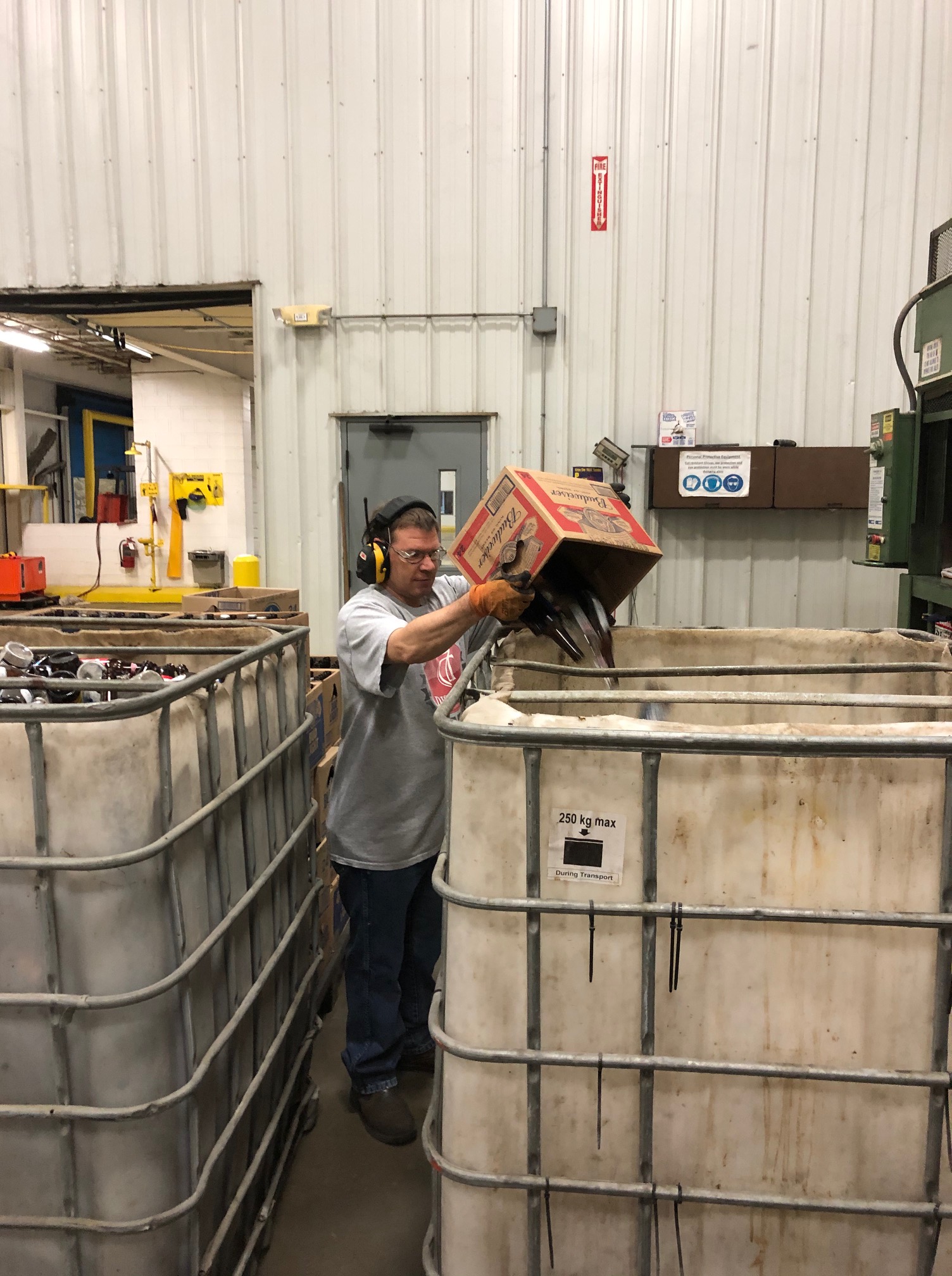
HALF EMPTIED: Travis Daniels wrangles returned bottles at 7G Distributing’s facility in Dubuque, Iowa. Photos Credit: Pat Schilling, Courtesy 7G Distributing
The beer distributorship’s ingenuity has been tested. They’ve tried turning returns into landscaping mulch by tumbling off the edges. They’ve tried mixing it into a specialized concrete. They’ve crushed it and had it hauled away.
“You don’t necessarily know where it ends up if you hand it off to a waste management company,” Lee says. Iowa doesn’t have a state system to track the fate of recyclables.
About six years ago, when 7G’s hauler initiated a new charge, 7G started looking into other options for its Dubuque operation.
In Kansas City, Missouri, Ripple Glass was expanding. It was started in 2009 by a founder of a brewery there to collect and process glass for recycling. “We collect as clean glass as possible,” says Lydia Gibson, Ripple’s director of sourcing. “That glass has a higher value because it takes less time, energy and resources to clean it up. That allows us to move that material economically in our geographic range.”
7G had clean glass, but handling it was unwieldy. “It’s pretty labor intensive to run it through the crusher,” Lee said. “You’re manually loading and it’s a little bit hazardous because you have flying glass.”
7G needed equipment. The state offered help.
“Glass is a no-brainer to try to get back into the manufacturing sector,” says Tom Anderson, an executive officer for business assistance in the Iowa Department of Natural Resources. A $20,000 grant helped 7G get shipping containers and a forklift attachment enabling the machine to lift and dump palletized boxes into a tractor-trailer.
7G and Ripple made a deal. Eighteen-wheelers started carrying 40,000-pound loads the nearly 400 miles from Dubuque to Kansas City.
“We don’t do enough volume to get paid for it,” Lee said. “With glass, you’re happy to efficiently manage it and not have to pay a fee. We want it to be recycled, not landfilled. So this kind of hit on everything.”
About 70 to 80 percent of 7G bottles come back, “a pretty darn good redemption,” according to Lee. He said the company has started handling another distributor’s returns.
Ripple, which also puts out collection boxes, turns the bulk of the glass into a grainy mix and sends it to nearby Kansas City, Kansas, for the manufacture of fiberglass insulation. It also processes and sorts glass into a stream of amber shards that goes to a bottle maker near Tulsa, Oklahoma.
“We’ve got kind of a nice, closed loop,” Gibson said. “You drink a cold one out of a glass Boulevard bottle. We’ll recycle it and get it right back into a new bottle.”
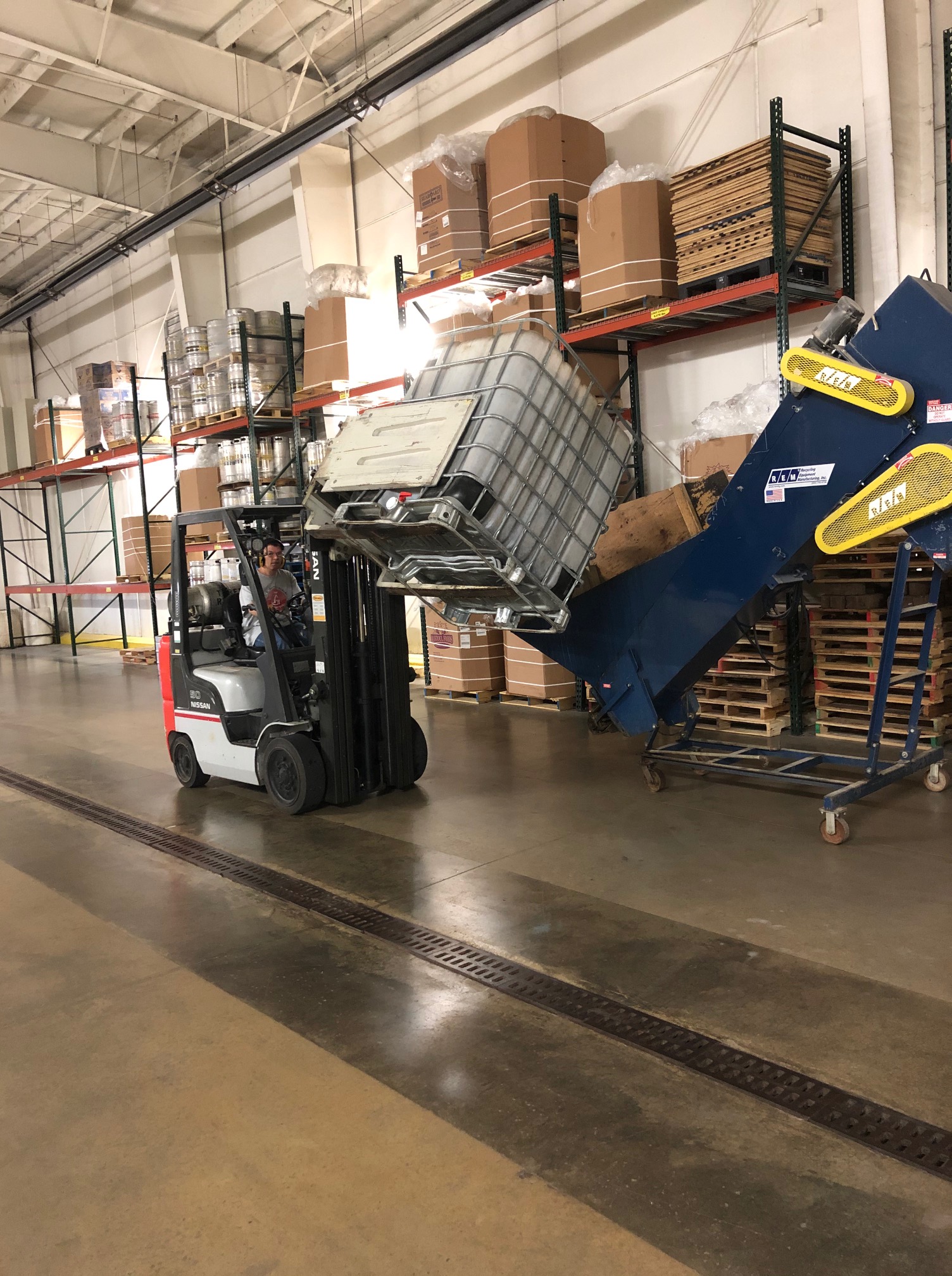
BIGGER GAME: Travis Daniels operates a forklift, equipped with an attachment to rotate containers, at 7G Distributing’s facility in Dubuque, Iowa.
Furnace Feeding In Minnesota
Kyle Fiebelkorn needs cullet. The recycled glass bits go in the recipe for making the food jars of clear glass that he produces at Anchor Glass in Shakopee, Minnesota.
“If you’re using more cullet, you can get it to melt out without pushing as much energy into it,” says Fiebelkorn, batch and furnace supervisor. It lowers power costs and the furnace can run longer before it needs to be rebuilt.
Fiebelkorn, a 27-year veteran of the work, said it used to be that for every 5 percent of cullet he could save 1 percent of energy. But he says the formula isn’t so simple. Gas and electricity costs, state mandates on cullet use to meet smokestack regulations, and cullet prices and access weigh into how much recycled glass goes in with the sand.
“Regardless, we have to find this cullet,” he said. “The public can bring glass to me. I’m pretty sure we’re the last glass factory doing it. I pay a lot more as an end user than the middleman.”
A recording on the answering machine quotes $70 per ton for clear glass, called flint. It moved up to that mark about six years ago and has held. “That’s our high-demand item,” Fiebelkorn said. Until about 2016, a second furnace produced amber glass containers, but that line moved to company plants closer to those customers. “I built up a pretty good mountain of amber,” he said. “I had to cut off the colored glass.”
The glass comes by truck and, over longer distances, by rail car carrying loads of 100 tons. Providers have included a pair of brothers with a pick-up truck and trailer, bringing loads once or twice per week that they’ve collected from bars in the southern part of the state. With the Covid-19 pandemic shutting bars earlier this year, the pace slowed. But that slice of the stream already was thinning.
“I used to go all around the Midwest doing recycling conferences,” Fiebelkorn said. “We’d do our spiel. But the big garbage haulers, a lot of them have bought up the smaller ones. There aren’t near the smaller ones like there used to be.”
Fiebelkorn said materials recovery facilities are doing a better job of separating recyclables and producing cullet. “It’s kind of a trend,” he said. “We all buy from the MRFs. It’s a lot more expensive than the old way for me. Cullet’s gotten a lot more expensive.”
Message In A Bottle Bill
Oregon installed the nation’s first bottle bill, in 1971. The deposit is a dime. Drink sellers, such as groceries, serve as redemption sites for recovering deposit money. Most large grocery markets provide “reverse vending machines” that scan containers and spit out receipts for redemption, says Peter Spendelow, a waste specialist, with 35 years at the state’s environmental quality agency. A drink distributor co-op operates so that they can each collect the other’s bottles.
Curbside recycling pick-up in the state includes a separate container for glass. It helps keep the glass clean, but it can’t compete with the quality of the glass collected from bottle bill redemptions, says Spendelow, who said the bottle law has faced little challenge. The bottle law has its exemptions, including liquor, wine and milk vessels.
Almost all of the bottle bills were adopted in the 1970s and 1980s. Hawai’i adopted one in 2005, with a nickel deposit. There’s also a penny container fee, which goes to support redemption centers. Billions of bottles have been recycled and litter reduced, with most glass shipped to California for re-manufacturing and some going to Korea, according to officials at the state department of health. Asked whether the law has broad support or faces repeal or change challenges, the officials stated in an email, “the bottle bill faces many challenges, including audits and threats to repeal the program that come up during Hawaii’s legislative session.”
Whatever the attributes of a bottle bill, the measure hasn’t gotten out of the sand in many places. Just 10 states have bottle bills. D.C., Maryland, Virginia, Minnesota and Missouri are not among them. Opponents include the National Waste & Recycling Association. The trade group in Arlington, Virginia, could not be reached for comment. But its position posted on its website, focusing on aluminum and plastics, says bottle bills “present an economic and disruptive burden to both recycling markets and local taxpayers.” Points include that “curbside recycling has been demonstrated to be more effective than bottle bills when it comes to increasing recycling rates” and that bottle bills “do not generate markets for recyclables.”
North Carolina doesn’t have a bottle bill. In 2008, the state decided to require that bars and restaurants have a glass recycling program as a condition for an alcohol license. It prompted a cottage industry of small-scale haulers who found it worth their while to collect the glass separately, says Mike Greene, of the state’s environmental and natural resources department.
“At first, it really did start a lot of mom-and-pop companies,” Greene said. One added the line to their business of providing bars and restaurants with arcade games and pool tables. “There are a lot fewer companies that are doing this now.”
The advantage hasn’t been necessarily obvious for everyone. There has been additional labor and training needed for workers, but savings on waste hauling where less weight means lower cost. Small haulers have been bought out by bigger operations.
“There was a lot of working with bar owners and managers to help them get better product,” Greene said. The law came with no other incentive than keeping an alcohol license. “As long as you were making an effort, no one was going after anybody,” Greene said. “Bar staff would have to figure out how to keep it separated. You would train someone how to recycle one week and then they’re gone the next.” Chicken bones sometimes land in containers meant for glass, which doesn’t help.
Greene, who previously worked on city recycling programs in Greensboro, said building recycling can be tough. “It’s a lot of hand-holding,” he said.
Meanwhile, D.C. residents are required to recycle “the full suite of materials” on the mayor’s 2018 list, including bottles and jars, “all items clean and empty.” The DPW website shows bottles and jars in green, amber and clear. Fines for “improper source separation of recyclables” go from $75 for a first violation to $1,000 for a fourth.
_________________



 Potomac Times