Feeding Jurors To Banks
Ward 3 Councilmember Mary Cheh says D.C. Superior Court’s debit card system for paying jurors “is concerning.” The bank debit cards come with risk of fees, restricted collection options and an agreement that surrenders the user’s Constitutional right to a trial by jury.
Cheh, a member of the D.C. Council’s Judiciary and Public Safety Committee, provided her view in response to Potomac Times reporting on the payment system. Cheh said the courts have to address the issue. She said the system is under federal control. The other members of the Committee — Vince Gray, Anita Bonds and Jack Evans — who were emailed the reporting did not respond. (Inadvertently omitted initially, Committee Chairperson Charles Allen also now has been provided the email, September 17.)
The D.C. Superior Court pays jurors with MetaBank debit cards under a program overseen by U.S. Treasury.
The debit card payment system was the focus of a federal class action lawsuit against JP Morgan Chase Bank, MetaBank’s predecessor, an action that claimed jurors were cheated out of their payments. The lawsuit was settled, with Chase Bank sending jurors checks for lost money in 2018.
In the past, D.C. Superior Court jurors could collect travel allowances in cash at a kiosk in the courthouse and other payments were made by check.
In a 2017 article, the National Center for State Courts in Williamsburg, Virginia, stated that courthouses have tried many ways over the years to streamline the juror payment process. The article, by Jury Studies Director Paula Hannaford-Agor, focused on Gwinnett County, Georgia, detailing complications with debit cards, such as fees, mailed debit cards being thrown out as junk mail, and the bank’s access to jurors’ personal information. The article noted that many jury managers are authorized to calculate and distribute checks to jurors directly.
Pay Jumps For D.C. Court Jurors, But Risk Of Debit Card Fees To Collect Stays
Chase Bank To Repay DC Jurors In Debit Card Fees Fight
5G Antenna-Home Spacing
Under new guidelines for D.C., antenna poles to support 5G wireless communication are set to come as close as 10 feet to buildings and multiple poles can be placed in stretches of street as short as 301 feet.
But some enclaves near the digital haven of Silicon Valley have decided on far wider separations, responding to concerns about aesthetics, rights-of-way intrusions and health effects.
Petaluma, for example, adopted an ordinance in 2018 requiring that each small cell be at least 500 feet away from any existing or approved residence. They worked out the measurements on their own in an attempt to balance interests.
“There is no county, state or federal standard recommendation regarding distance from residences,” the assistant city attorney and economic development manager stated in a July 2018 memo to the mayor and city council. “Requirements from various jurisdictions show no consistency, with many having no regulation regarding distance from residences.” The staff recommended that the residential buffer be set at 200 feet. But the city decided to go more than twice as long, also requiring:
- All ground-mounted equipment not installed inside the pole must be undergrounded, flush to the ground, within three feet of the utility pole
- Each small cell must be at least 1,500 feet away from the nearest small cell facility
- Aside from the transmitter/antenna itself, no additional equipment may be visible.
Mill Valley, in Marin County, also set its minimum separation for small cells at 1,500 feet.
These lines have been drawn despite the extensive leeway federal and state law have granted telecommunications companies to install infrastructure.
But an order by the Federal Communications Commission in 2018 to expand that leeway for 5G hit a wrinkle August 9, 2019. The U.S. Court of Appeals for the District of Columbia Circuit pushed the FCC order back to the agency after a challenge by environmental groups and Indian tribes concerned about loss of reviews on rollout of the technology. The Court stated that the “Commission failed to justify its confidence that small cell deployments pose little to no cognizable religious, cultural, or environmental risk, particularly given the vast number of proposed deployments and the reality that the Order will principally affect small cells that require new construction.” The Court opinion noted an estimated deployment of 800,000 small cells.
The FCC responded the same day with a statement that it was reviewing the decision and would “look forward to next steps, as appropriate”. The agency said it was pleased by the parts of the order that the Court affirmed, including “that parties cannot demand upfront fees before reviewing any cell sites, large or small.”
5G Antennas Raise Stir As Sites Picked In Palisades And Near Ward Circle
GU Road On Overdrive
Georgetown University, with construction of the new East-West Road on its north side slowed due to “significant subterranean impediments”, asked August 15 that ANC 3D support a continuation of expanded work hours.
The schedule allows non-heavy machinery work on the project from 5:00 a.m. to 11:00 p.m. every day, with heavy machinery operating from 7:00 a.m. to 10:00 p.m., Monday through Friday, and from 8:00 a.m. to 7:00 p.m. on weekends and holidays. In a September 4 letter, the ANC 3D supported the expanded hours. The Commission added that if the neighboring community experiences “significant and verifiable adverse impacts during the extended heavy machinery hours, we ask that you agree, to a delayed 8:00 a.m. start time and/or an earlier 9:00 p.m. end time upon request by” either 3D09 Commissioner J.P. Szymkowicz or ANC 3D Chairperson Chuck Elkins.
The job is expected to be finished by October 31, 2019, according to the letter. The East-West Road will introduce intensified two-way traffic along the border of Glover Archbold National Park and Gate 4, beside the Park, will become a new Reservoir Road intersection, with installation of a traffic light planned.
Spring Valley’s $300 Million FUDS
July 2020 is the target for wrapping up work at what’s formally known as the “Spring Valley Formerly Used Defense Site”. But the work to address the residue of WWI weapons development in a 650-acre area around American University might go longer, depending on new tests underway and what agency officials decide to do about contamination. The project started in 1993 after a utility excavation job uncovered munitions. More than $300 million has been spent on myriad tasks, including earth removal, testing, “anomaly” investigation, grounds keeping and payments for damaged properties. Officials provided a project update at a September 10 meeting of the community Restoration Advisory Board.
Spring Valley Groundwater Tests Resume In $300 Million WWI Weapons Residue Project
More Bikeshare To Go Around?
Automobile-jammed roads and desire for fitness add to the attraction of bicycles. Another option to pedal might have come a step closer on September 4. Acting on a request from bike enthusiast Brett Young, an ANC 3D letter recognized an “urgent need” for a Bikeshare Station for the Palisades and Foxhall Village and voted to recommend that the city transportation department install a facility at Hardy Recreation Center.
Trestle Travail
The government shutdown of the trailhead at the south end of Glover Archbold National Park is now in its fourth year, as agency officials try to figure out whether to fish or cut bait on the abandoned streetcar trestle that spans the Park at the site beside Canal Road.
The city transportation department has been studying the feasibility of restoring the Foundry Branch Trolley Trestle as part of a Palisades bike and pedestrian trail. Bridge custodian WMATA has advocated for demolition. A report on the restoration feasibility is expected to go to Advisory Neighborhood Commissions in October, according to transportation department bicycle program specialist Michael Alvino. A decision on an appeal to the Mayor’s Agent for historic preservation of the bridge was put off at the end of a hearing earlier this year.
Four-Hour Hearing Leaves Trestle’s Fate Hinged On Pending DDOT Study
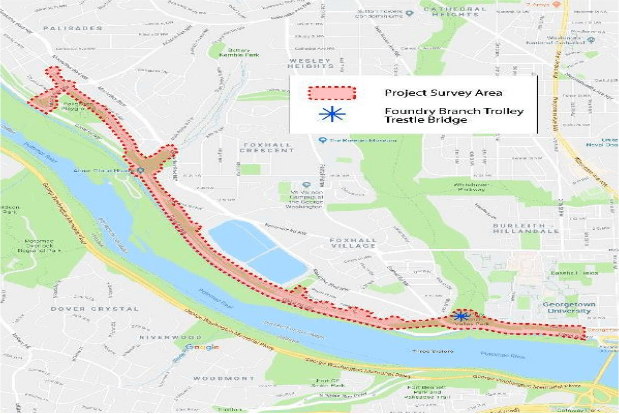
Area of Palisades multi-use trail feasibility study. Source: DDOT


 Potomac Times