Four sites in the ANC 3D area are targeted for antennas to support rollout of the 5G wireless communication system.
5G is expected boost capacity and speed, with a network of antennas that will be closer to the ground, and more densely arrayed around the city and of lower power than equipment associated with the existing 4G system.
Some people now use multiple cell phones. They have laptops and tablets. Children are equipped with their own battery of devices. Cars are increasingly being outfitted with online access. The current network is straining to keep up, according to Verizon’s Mario Acosta-Velez and Brian Stover, who appeared at ANC 3D’s July meeting to talk about how the installations are expected to unfold.
Not everyone is happy. Some people are worried about new pole placement in neighborhoods already crowded with poles. Some are concerned about health effects of the technology.
Acosta-Velez said 1G was voice transmission; 2G was text; 3G was internet access by phone; and 4G is video streaming; and now 5G means keeping all the facets running fast and with greater data capacity. That capacity, for example, will enable sensors that will track traffic around the city and support automation of signaling, Stover said.
For ANC 3D antenna locations, Verizon has targeted two sites for 5G antennas, one at W Street and MacArthur Boulevard and the other just south of W Street and Foxhall Road. ATT has targeted a site at 4300 Massachusetts Ave., near the American University’s Katzen Arts Center and one near Hawthorne Place.
The 5G equipment includes an antenna and a radio, consolidated at the pole top, the proximity adding speed, according to Stover.
“To get the speed we need, we need a dense population of these small cells throughout the city,” Stover said. He estimated that about 10 percent of D.C.’s 71,000 light poles will be used. Power utility poles also may be used. Stover said 5G installation is beginning with the city’s core and that 4G equipment, which includes some antennas on the tops of buildings, will remain for some time.
Pole placement is a sensitive subject for residents who say their streets already are pole-jammed in places. “When you drive through Wesley Heights you will see people with three poles in front of their house,” one woman said at the ANC 3D meeting. “We have three now.”
Another questioner called management of attachments to poles a “colossal mess. It’s arbitrary what’s on the poles. Nobody knows what’s going on with our poles.”
The D.C. Department of Transportation, which has authority over streetlight poles, developed guidelines for antenna and pole placement. Restrictions are extensive and detailed.
For example, limits are set on the number of antennas per “blockface interval”, with one allowed for 0 to 150 feet and three for 601 to 750 feet. Standalone poles must be at least 10 feet from a building and a minimum of 3 feet from bicycle racks. Poles shall not interfere with Capital Bikeshare docks and stations. And “to the maximum extent possible,” pole placement that blocks window views or “detracts from the building’s architectural quality” should be avoided and should not “prevent solar access to the solar panel.” Restrictions are tighter within “Areas of Special Interest”, including historic districts.
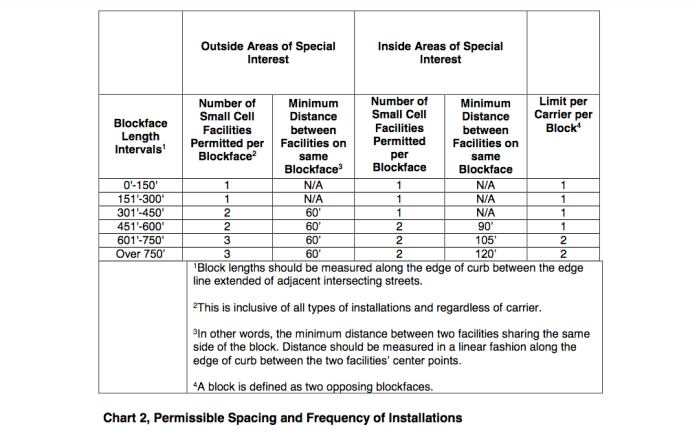
Source: DDOT Small Cell Design Guidelines, adopted March 21, 2019
Stover said existing poles will be used wherever possible, but positioning needs to geographically fit the network. “Once you find that sweet spot it’s very hard to turn down,” he said. “Verizon will try to accommodate requests, but there is no promise we can move it to someone else’s backyard or not install it.” Stover said the antennas, to be placed about 25 feet off the ground, transmit about 1,000 feet, depending on the terrain.
A DDOT official on hand, Manager of the Neighborhood Planning Branch Anna Chamberlin, said development of the guidelines included consultation with people in planning agencies, other cities and the industry.
Local public officials and residents living on the streets targeted for antenna placement must be notified, according to the guidelines and statements at the meeting. But if placement complies with DDOT guidelines, the placement will be permitted, according to DDOT.
In introducing the 5G topic, ANC 3D Chairman Chuck Elkins said the Federal Communications Commission decided 5G should be made accessible across the country quickly and that debate by local jurisdictions would delay rollout. “So they decided to preempt many of the decisions you might expect cities to make,” Elkins said.
But some jurisdictions, including in California, have opposed 5G installation.
Multiple wireless providers can place antennas within a stretch of street, but the total number cannot exceed the limit in the guidelines. Stover said sharing of a pole by providers is too unwieldy to be practical.
“Is That A ‘Yes’ To They Emit Radiation?”
While DDOT’s pole placement guidelines offer specific measurements, the discussion about health effects was less clear. Concern about health effects was raised at a meeting in April of the Foxhall Community Citizens Association with Ward 3 Councilmember Mary Cheh, who said that the city had been preempted by federal authorities.
In response to questions at the ANC 3D meeting, Stover said the system is regulated by the FCC. “We have to rely on the FCC,” he said, adding that other federal agencies that focus on health and safety are involved in the FCC’s regulatory work. “These antenna are much lower power and hence can be closer to the street.”
Communication about the complex technology isn’t necessarily fast or clear. When someone asked about radiation emissions from the equipment, a terminology scuffle ensued.
“They emit RF energy, radio frequency energy,” Stover said.
“Is that a ‘yes’ to they emit radiation?” someone asked.
“They emit RF energy,” Stover repeated. “Your TV uses it, your baby monitor uses it, your garage door opener. It’s present all around us. Your cell phone operates on it.”
A glossary accompanying the DDOT guidelines states that an antenna is an “apparatus designed for the purpose of emitting radio frequency (RF) radiation, to be operated or operating from a fixed location, for the transmission of writing, signs, signals, data, images, pictures, and sounds of all kinds.”
At least one ANC commissioner wanted to know what to tell his constituents who are concerned about health effects. Acosta-Velez noted that handouts were available and that he would be reaching out to commissioners about the issue.
Someone else worried that Ward 3 might be left behind the 5G curve because of residents’ tendency to contest matters.
Others voiced eagerness for 5G. ANC 3D07 Commissioner Taylor Berlin, an American University student, said, “I know how excited we are to be in a ‘smart city’ with better connectivity for our ‘smartphones’ and our laptops. I know my constituents would love to have 5G towers near our campus.”
FCC On Wireless Health Risk
DDOT’s FAQ on 5G includes an item about health concerns, simply directing the curious to the FCC at FCC.gov or 1-888-225-5322. Plugging “5G wireless antenna health risks” into the FCC website search box produced no obviously linked information.
Checking with the FCC media office, I was told: “Radio frequency emissions from antennas used for cellular transmissions result in exposure levels on the ground that are typically thousands of times below safety limits.
“These safety limits were adopted by the FCC based on the recommendations of expert organizations and endorsed by agencies of the Federal Government responsible for health and safety. Therefore, there is no reason to believe that such towers could constitute a potential health hazard to nearby residents or students.”
Also, in “Wireless Devices and Health Concern”, the FCC states that its guidelines, based upon standards developed by the Institute of Electrical and Electronics Engineers and the National Council on Radiation Protection and Measurements, specify exposure limits for hand-held wireless devices.
The FCC requires that all wireless communications devices sold in the United States meet its minimum guidelines for safe human exposure to radio frequency energy.
The document goes on to say, “those evaluating the potential risks of using wireless devices agree that more and longer-term studies should explore whether there is a better basis for RF safety standards than is currently used.” But the agency says, “at this time, there is no basis on which to establish a different safety threshold than our current requirements.”


 Potomac Times