Heavy equipment beeping and grinding. Torn up streets. Makeshift water piping snaking at your feet. Sticky asphalt bits tracked into the house. Piles of construction supplies.
The waterworks rehab in Foxhall Village, planned for February to August, is now expected to go on for another two months in the wake of a midcourse dispute about how to do the job. DC Water, its contractor, J. Fletcher Creamer & Son of New Jersey, and D.C. Department of Transportation officials have not seen eye to eye about street side tree protection and temporary bypass pipe placement.
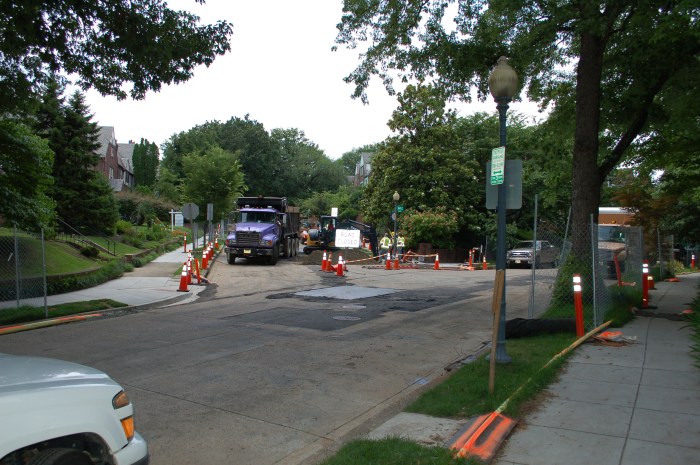
WATERWORKS WORK: Construction crews go about their trade at Volta Place and 44th Street, part of a water line rehabilitation project in Foxhall Village, a job slowed by midpoint disagreement about whether street side trees should fenced or free and whether yellow temporary bypass pipe should be gutter-bound or along the sidewalk. Photo Credit: John A. Bray
In a way, it’s a classic contest between the regulator and the regulated, with the public being left to endure what looks like waste and needless confusion. Tempers have flared. Utility work — gas line and sidewalk renovation — kicked up dust in the Village for much of 2016 and 2017. (Foxhall’s Endless Gas Pipe Job)
DDOT’s project permit for the water system work required that all street side trees be fenced. Apparently, transportation agency officials also intended for the bypass piping to go in the street gutter, though the placement is not listed along with the fencing among the extensive permit conditions. The contractor fenced some trees and put much of the piping along the sidewalk.
For the DC Water manager overseeing the $4.3 million contract, which involves similar cleaning and relining work in North Cleveland Park, those concerns have been secondary to getting the work completed with as little disruption and delay as possible. “We did not want to delay them so we allowed them to proceed,” said Nyika Roberson-Ramos of DC Water.
Disagreement spilled onto the Village street on May 9, when a coppery contractor F-150 pulled up to the curb about 7 a.m. and the driver hopped out to take the pulse of passersby, including me, about the prospect of a project delay to satisfy DDOT. He said that either positioning of the piping posed risks. “We’ll have to move it if they say we have to,” he said. “It’s a fine of $1,000 a day if we don’t.”
Eventually, some bypass piping, along Foxhall Road, for example, was moved to the gutter, while sections along 44th Street stayed put along the sidewalk. The condition of bypass pipe is consequential, since it supplies residential drinking water and feeds stand-in fire hydrants. Fencing was added for some trees, but not others.
Attempts over two weeks to obtain an explanation from DDOT for why some trees were going unfenced and the rationale and necessity for bypass pipe repositioning were fruitless. The contractor did not respond to requests for comment about their approach.
Roberson-Ramos, who notified the community of the project delay, told me that pipes on the sidewalk pose a trip hazard and that residents have complained about obstructed passage and other concerns, with some yelling at her. Bypass pipe disconnection and repositioning required multiple tests for cleanliness. Roberson-Ramos said that requests from residents to replace lead pipe on the private side of the service line also have slowed the project, with requests by early June totaling about 35.
She said the contractor would be required to bear the additional costs associated with changes related to meeting permit requirements. “They are pretty much out there doing whatever at their risk,” she said.
(Adding an article comment? Comments must be signed by the writer, include the writer’s area of residence, and typically should not exceed 250 words.)
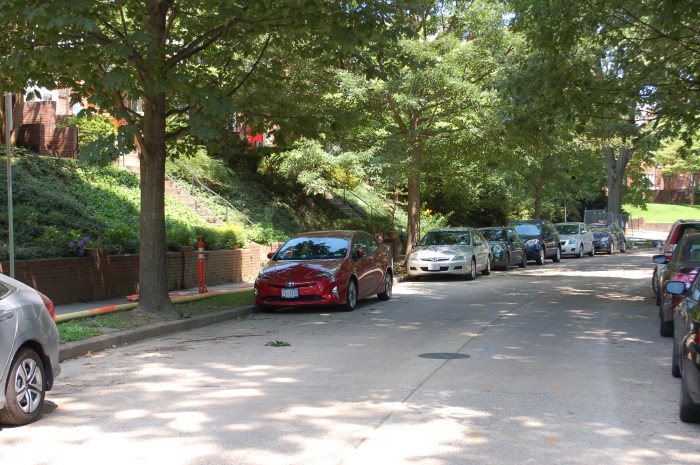
CAGE-FREE: Some trees along a stretch of 44th Street in Foxhall Village go without fencing required under a water pipe rehab project permit. Photo Credit: John A. Bray
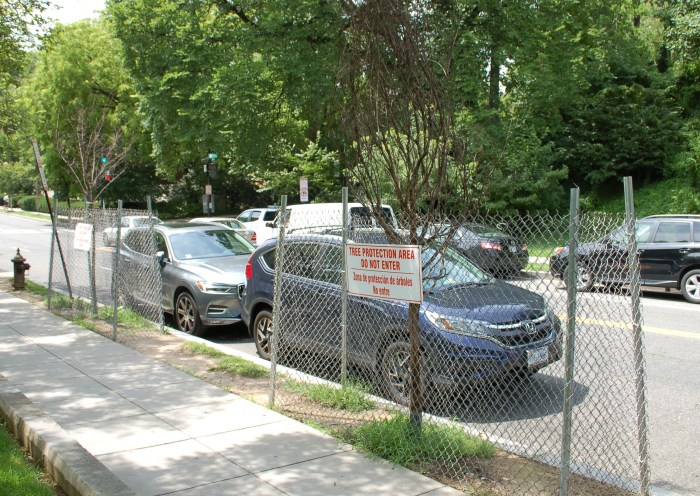
DEAD ZONE DEFENSE: The D.C. Department of Transportation requires fencing of trees near construction to protect against damage, including to roots from activity such as heavy equipment crossings that compact soil. Fencing provides no assurance of tree health, as caged specimens along Reservoir Road, in front of Georgetown University, indicate. Photo Credit: John A. Bray


 Potomac Times