On Dec. 29, 2017, my wife and I made a routine D.C.-Dulles Airport run to drop her sister for a flight after a holiday visit.
I forgot about it – until two months later, when the mail slot produced an I-66 E-ZPass Toll Violation Notice: “You owe $5.50.”
Hunh? I had no recollection of entering a pay lane. Traffic wasn’t heavy and I trust myself to avoid needless fees. But the roads around the metropolis seem like they are getting awfully cluttered with automatic tolling mechanisms that are increasingly difficult to resist — or comprehend.
On my notice, there was a black box, where an image of the vehicle is supposed to appear, inscrutable toll plaza and lane codes and entry and exit times. My alleged/accidental stay “on the Express Lanes during the High Occupancy Tolling period either without an E-ZPass transponder or without adequate funds on your E-Zpass account” lasted 5 minutes and 5 seconds, at about 6:15 p.m.
I was given 30 days from the date of the February 14 notice to pay or file a dispute. The notice wasn’t posted until February 21 and it didn’t reach me until even later. Is there no tollbooth statute of limitations?
I could dispute it, perhaps citing the “HOV 2+ No Toll” rule, but could I marshal in time evidence proving the number of car occupants. According to toller rules, contesting wouldn’t change the payment due date. Payment after the due date activates a $25 “administrative fee” for each violation, and if the matter goes to court, only the court can handle payments. That sort of arrangement mounts up fast in time and money.
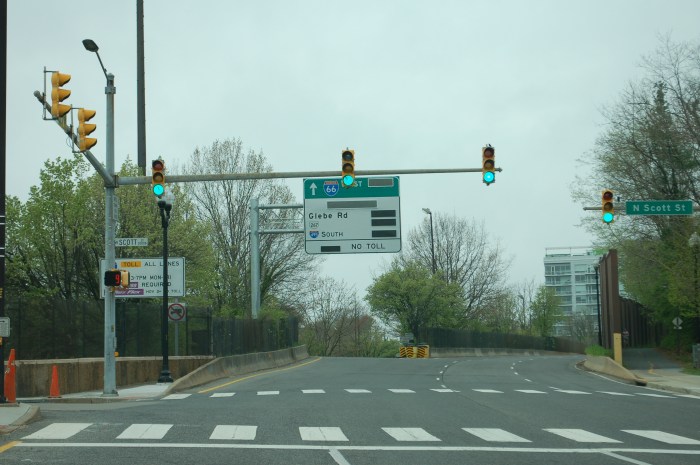
FOR WHOM THE TOLL: Virginia now has 15 “toll facilities,” run by a variety of organizations of different composition, including private and public, according to Virginia Department of Transportation officials. The facilities are part of a network in 16-states that accepts E-ZPass. Virginia has 1.2 million pre-paid accounts, with a total balance of about $60 million, and 2 million associated transponders that key the tolls and activate payment to the various facilities. The I-66 facility is a VDOT operation. Officials said VDOT has a $9 million annual contract with a private company, which runs a call center in Clifton Forge and manages the accounts, and all of the more than 225 million transactions per year go through that “back office.” The E-ZPass system costs the state $26 million per year to run, a bill defrayed by a 6.39 cents fee per transaction. They were unable to tell me how much money is collected annually in Virginia through the E-ZPass system or provide an annual report on the system. Photo Credit: John A. Bray
When I called the 877-number about the notice, I was told there was a photo of my license plate, not a black box. The attendant said I was lucky because, with most people, after not paying for a period such as mine, administrative fees kick in and rise over time. Indeed, my notice included a special “courtesy” of waiving the “typical” $12.50 administrative fee for violations such as mine “because of the new operational characteristics of these Express Lanes.” Was my toll just my fair share?
Checks And Balances?
E-ZPass timeliness and accuracy with violation pursuits isn’t a problem in Virginia, at least not according to the office of Auditor of Public Accounts Martha S. Mavredes. The audit report of the system is exempt from public inspection because, according to the response to my Freedom of Information Act request, it contains: “Information that describes the design, function, operation, or access control features of any security system, whether manual or automated, which is used to control access to or use of any automated data processing or telecommunications system.”
Nevertheless, I was assured that, “For toll violation notices, the auditors tested controls to provide reasonable assurance that ‘violation data and matched customer violation information is initially recorded, posted and billed accurately, timely and completely’ and no exceptions were noted in any of this work.”
The tolling stakes are considerable. According to officials of the office of Virginia Department of Transportation Commissioner Stephen C. Brich, the state has 15 E-ZPass “tolling facilities,” which rack up more than 225 million transactions annually. VDOT was unable to tell me how much money is collected annually in Virginia through the E-ZPass system or provide an annual report that might be expected to summarize what happens to the money.
Such questions aren’t novel. In 2009, the U.S. PIRG Education Fund reported its concerns about tolling. Those concerns, described in “Private Roads, Public Costs: The Facts About Toll Road Privatization and How to Protect the Public”, included loss of public control and inadequate transparency to protect public interests.
I paid the toll. A $5.50 fish might not seem like much to fry over. It’s clear, though, that it’s a catch worth a toller’s trolling — and multiplying – and that vital accountability to the public is slipping through the nets.


 Potomac Times