Barricaded for more than a year because of safety concerns, the south end of the Glover Archbold National Park trail that runs under a dilapidated trolley trestle remains closed as the government agencies involved try to decide what to do about the structure.
The trestle, once a conduit for streetcars, has been falling apart for decades. And all along, people have been traversing the trail under the rusted steel hulk, and they still do, despite the warning signs and posted detour.

TRESTLE TROUBLES: Rain falls August 29, 2017 on the abandoned and rusting streetcar bridge at the south end of Glover Archbold National Park, where officials closed the trail more than a year ago because of concern about safety. Photo Credit: John A. Bray
But the abandoned trestle isn’t the only structure along the trail that is in limbo.
A nearly century old and deteriorating major sewer that runs through the park faces an uncertain fix and the revamping of a pipe junction box it feeds into by the Potomac River is pending design approval.
Park erosion continues apace, with heavy recent rains adding to the debris piles against sewer accesses and washing out a boardwalk along the trail, just north of the Reservoir Road berm, which is holding back an expanding mud flat. (See, Runoff: Glover Archbold National Park, September 9, 2016, TheHoe.org)
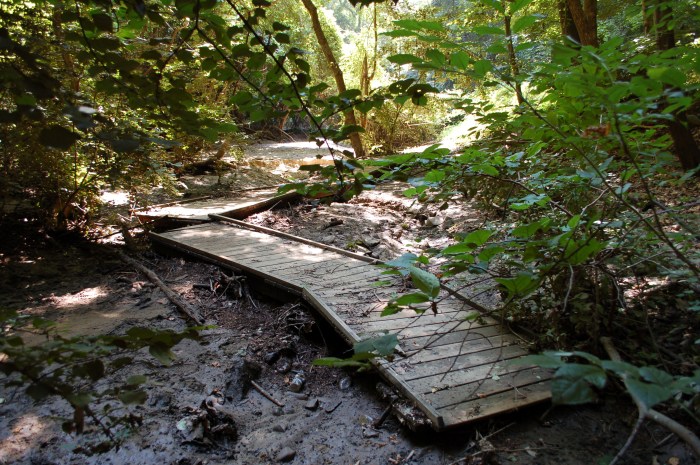
EX-WALKWAY: A boardwalk built over a muddy storm water drainage area sits askew in mid-August 2017 after heavy rains. Photo Credit: John A. Bray
The National Park Service manages the park, which runs between Van Ness Street and the C&O Canal. The Washington Metropolitan Area Transit Authority owns the trestle. The DC Water and Sewer Authority oversees the pipework, which handles sewage and storm water.
NPS closed the trail under the trestle on August 8, 2016 and noted a plan for a covered walkway under the trestle. But it has yet to be installed. The snow fence barrier has been broken, allowing people to easily pass.
WMATA seeks to push trestle ownership to the District of Columbia via the city transportation department, according to WMATA spokesman Richard Jordan.
“We are focused on addressing the Metrorail system’s infrastructure needs and challenges,” Jordan said. “Meanwhile, in the short term, Metro is working through the permitting process with the National Park Service on a covered walkway.”
The trestle’s condition was evaluated in 2014 by Structura, a Rockville, Maryland, firm, with the goal to determine whether it could someday be used as a bike or pedestrian path, according to the company’s website.
Asked for a copy of the report, Jordan responded with an e-mail directing me to file a formal request. “The document you are requesting may contain sensitive information and therefore is subject to PARP,” the e-mail stated, referencing WMATA’s Public Access to Records Policy. It includes a fee structure, where the first 2 hours of search and review time are free. “Thereafter, requesters are generally assessed processing fees calculated at the employees’ basic rate of pay, plus an additional 50 percent to cover benefits, for the time spent responding to the request for records,” says the website.
Jordan was able to let me know the cost of the report, which was $31,216. Three years later, to what use the report has been put is unclear.
Meanwhile, at least on paper, movement has occurred on long-awaited action regarding the park sewer. DC Water submitted a draft environmental assessment to NPS on January 30, 2017, according to DC Water officials. However, several more drafts might be produced before the document is “deemed ready for public review,” according to DC Water’s Emanuel Briggs, Manager, Community Outreach, External Affairs. Briggs said NPS will decide when the document containing options goes to the public.
It was nearly four years ago that DC Water closed a public comment period on the scope of the project.
The average daily flow through the pipeline totals about 2.4 million gallons, and the pipes have cracks, holes and root intrusion, according to DC Water and NPS. The NPS goal is to fix or relocate the sewer. NPS officials said in late June 2017 that “although the sewers are not known to be leaking at present, their condition is expected to deteriorate over time.” They said Rock Creek Park staff have commented on the assessment.
Work on the sewer junction box, which sits at the south end of the tunnel under Canal Road, requires design approval by NPS. A meeting about it is expected sometime in September 2017, according to DC Water officials, who said that the project would take about four months to complete. A detour was installed on the Crescent Trail.
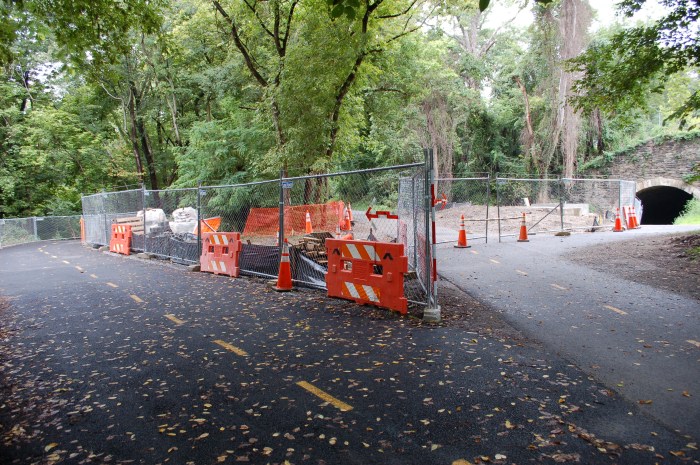
GO-AROUND: A detour gives passersby on the Crescent Trail at the Canal Road tunnel a way around a pending sewer junction box rehabilitation project. Photo Credit: John A. Bray
The park sewer has been running through the junction box to an 84-inch pipe along the river, where it meets up with a flow from areas to the west on the way to the Blue Plains treatment facility, according to Tayo Olatunji, the construction project supervisor. Rehabilitation of the box will allow flexibility to shift the flow to a 48-inch line that runs along the Crescent Trail and was recently relined with a specialized insert, among the methods discussed for repairing the pipe through the park.
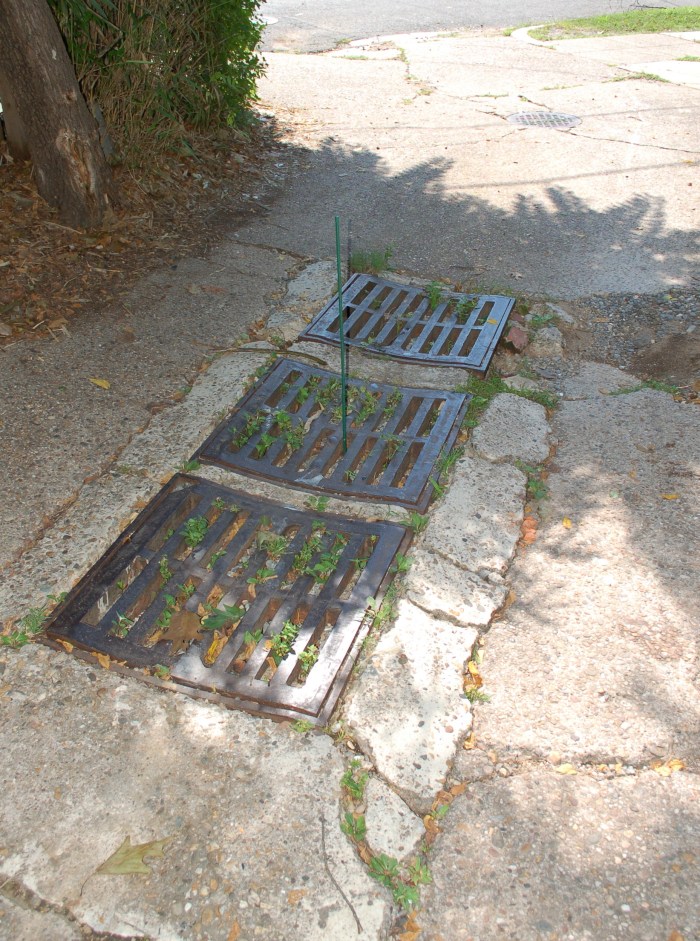
DRAIN?: With worry rising about the capacity of urban areas to absorb heavy rains and keep homes dry, sediment is packed to the top of an alley sewer grate at the south end of 44th Street beside Glover Archbold National Park. Other grates in the community have standing water and debris near the surface. Photo Credit: John A. Bray



 Potomac Times