MedStar Georgetown University Hospital is on the hook for raising $112 million in philanthropic aid to help pay for the Hospital’s expansion and renovation, or about 20 percent of the cost of the $567 million project.
But if the Hospital’s Office of Philanthropy comes up short on the money, MedStar Health Inc. says it can tap into its $1.8 billion in unrestricted cash and investable assets on hand to cover, according to public records filed with the D.C. Health Department.
MedStar Health, described as a $4.6 billion Columbia, Maryland-based not-for-profit company with 10 hospitals and 20 other medical facilities in the region, controls the GU Hospital and anticipates steady growth, according to Certificate of Need application documents. The application was filed by MedStar in October 2015, with the company saying that it needs to modernize its facilities.
The need certificate was approved in March 2016 by Amha W. Selassie, director of the department’s State Health Planning and Development Agency. His action followed a recommendation of approval by the staff and review by the advisory Statewide Health Coordinating Council, which currently has 11 members. Four members — Robert Brandon, Zinethia Clemmons, Goulda Downer and Brenda Kelly — participated in the vote on the matter and gave their approval, according to a meeting transcript.
On June 8, 2017, the five-member D.C. Zoning Commission, after a 50-minute meeting and with no one speaking in opposition, voted 4-0 to approve the project. Voting were Anthony J. Hood, Robert Miller, Michael G. Turnbull and Peter G. May. Peter Shapiro was absent.
MGUH Revenue, Admissions Rising
MedStar owns the hospital buildings and will own the six-story surgical pavilion to be constructed on the northeast side of the current facility. MedStar has a $1-per-year, long-term lease for the GU-owned land under the facilities, according to the lease signed in 2000. The lease was modified to add the land that the new facility will occupy.
Capital costs for the expansion include $124 million in pre-operational costs, $68 million in financing costs, $223 million for construction, $98 million for equipment, and a $42 million contingency fund. MedStar proposes to finance the project with a $371 million bond issue, with an interest rate of 4.85 percent, adding $84 million from cash on hand, the public records show.
The 4-year building project, set to begin soon, also involves “backfill” renovations of the 60-year-old existing hospital facilities, including conversion of semi-private beds to private. All beds in the surgical pavilion will be private, in 280-square-foot rooms. The total number of hospital beds in use is to rise from 416 to 538, an increase of 29 percent.
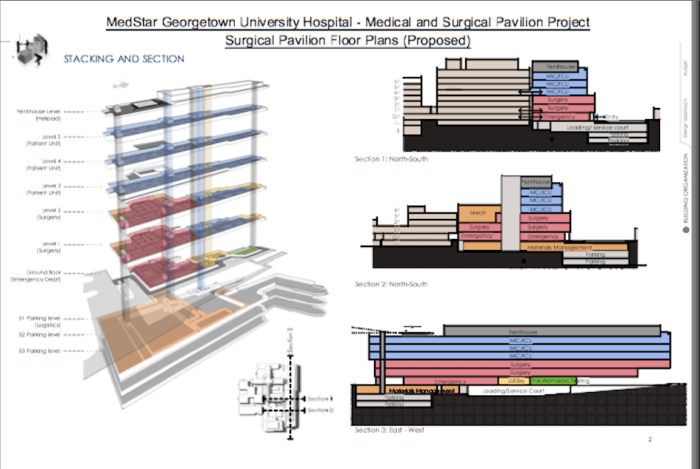
Proposed MedStar Georgetown University Hospital Surgical Pavilion Floor Plans, from public certificate of need filings with the D.C. Health Department.
One of the questions facing the health department agency was MedStar’s capacity to carry the cost of the project.
MedStar says MGUH “will actually improve its effectiveness and efficiency and fully recover the capital to be invested in the surgical pavilion and Hospital renovation project by 2024,” according to the application.
Higher numbers of admissions and emergency room visits, and increased acuity of cases for inpatients are projected, according to MedStar. The average charge per inpatient day has been steadily rising, going from $9,785 in 2013 to a projected $13,609 in 2022.
MedStar says total revenues, after reductions from bad debt, free and indigent care and “contractural allowances,” have been rising, from $860.2 million in 2013 to a projected $1 billion in 2016. In 2022, the figure is projected to reach $1.4 billion. The allowance for “free care and indigent” in 2013 was $37.4 million and is projected to be $63.9 million in 2022.

MedStar Georgetown University Hospital Revenues chart, from public certificate of need filings with the D.C. Health Department.
The most recent MGUH financial profile data displayed by the American Hospital Directory show gross patient revenue of nearly $2.5 billion and net income of just over $100 million.
In the application, the Medicaid percentage of the Hospital’s patient mix is projected to drop slightly to 6.6 percent by 2021, while the Medicare percentage is projected to rise slightly to 30.2 percent. MedStar says the commercial/managed care percentage is projected to fall slightly to 61.5 percent. Nearly two-thirds of MGUH admissions come from Maryland and Virginia.
Community Health Beyond The Hospital
Conditions that came with approval of the need certificate include requirements that MGUH develop programs with the DC Primary Care Association and set up other mechanisms to provide general and specialized care services to uninsured, underinsured and at-risk D.C. residents.
In the CON approval document, Selassie, the planning agency director, notes the need for “underlying causes of persistent health problems” to be addressed and that “providing surgeries and emergency room services” isn’t enough.
“In other words,” Selassie says, “instead of waiting for patients to come to the hospital, the hospitals should expand their outreach to the community.”
Asking for increased access for “vulnerable populations is not meant to put additional burden on the facility,” Selassie says. Providing community benefits is required of “non-profit hospitals” by the Internal Revenue Service as part of qualifying for tax exemption, he says, adding D.C. law requires “a reasonable volume of uncompensated care.”
The CON approval calls for regular updates on how the Hospital is handling the responsibility.
According to the company’s application, “MedStar’s hospitals have met and will continue to meet applicable community benefits and uncompensated care requirements.” The application says that in 2014 MGUH alone provided $41.7 million in charity care and $3.7 million in community-based health services.
© 2017 John A. Bray


 Potomac Times