On April 5, 2017, after six months of tumultuous Washington Gas line renovation on a half-block section of Foxhall Village in Washington, D.C., a crew poured and smoothed concrete to resurface the dug-up street. It looked like the project had finally ended.
But beneath the concrete trouble was brewing. A sewer lateral serving one of the houses was broken. It clogged, causing a sewage backup, the second such incident during the course of the project.
A mere 10 days after the street was repaved, on April 15, a Saturday, a sewer pipe repair crew sawed a hole in the crisp concrete to access and repair the broken lateral pipe.
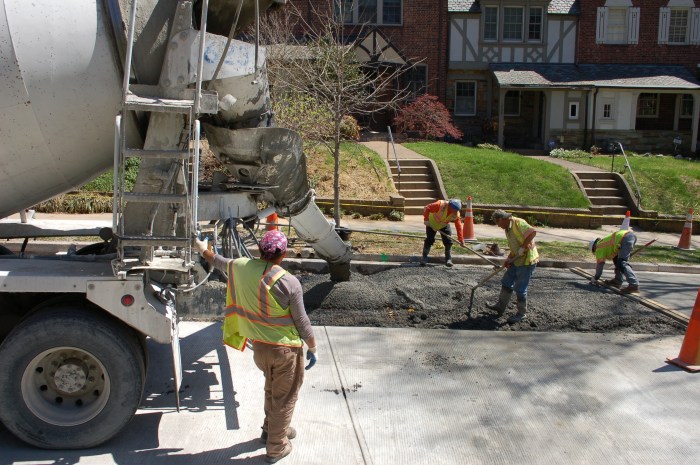
NEW STREET: A paving crew pours and smooths concrete on a stretch of 44th Street in Foxhall Village on April 5, 2017, after six months of gas line work. Photo Credit: John A. Bray
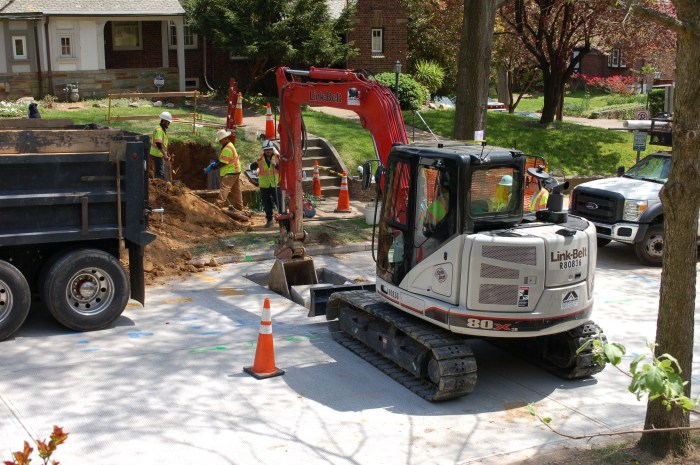
UTILITY VAULT OPENING: On April 15, 2017, to fix a broken sewer lateral, a crew digs into the concrete of a section of 44th Street that was repaved 10 days earlier street. Photo Credit: John A. Bray
Six weeks later, on May 31, another crew showed up to jackhammer and repave a new section of the street around the asphalt-patched access hole. Could this now be the end? Might there be other pipe damage below the concrete that could take months or years to become apparent?
More Gas Pipe Work Ahead
Washington Gas has projected that more work in Foxhall Village, among other places across the city, is on the way, begging questions about costs and oversight, and what can be expected with coming pipe jobs. A member of the crew said the April 15 sewer lateral repair job would cost $10,000. Gas customers have been steadily paying for the pipe work, at least since April 2015, with an itemized but changing charge on monthly bills.
The Washington Gas project was to upgrade pipes in the street and service lines to houses, replacing metal pipes with flexible yellow plastic tubes. Meters inside houses were moved to the outside. (See, Gas Man In The Garden) Work on the short stretch of 44th Street, north of P Street, occurred in fits and starts, beginning in November 2016, a period that included firefighters responding at least twice to nighttime gas leaks. (See, Another Foxhall Village Gas Leak)
Keeping the crucial contents of the utility pipe networks all flowing properly poses a complex challenge, including delicate excavations with heavy hydraulic equipment and hand-held shovels. It involves multiple agencies, companies and contractors, with varying lines of authority. Keeping track of what’s happening with underground utility work and preventing damage is no easy task. How and when the sewer pipe damage on 44th Street occurred and who is responsible is unclear.
In Washington, D.C., the number of utility line damage incidents in 2015 totaled 246, according to incident data in Common Ground Alliance’s 2015 DIRT Report Interactive Analysis. The Alliance, formed in 2000 and supported by many utility companies, says its data program emerged out of a 1999 report on damage prevention sponsored by the U.S. Department of Transportation. Awareness of the importance of calling 811 to have utilities located before excavations is growing, the group says. But spray-painting markings of underground lines bestows no immunity.
The cost of damage is another matter. A report by Nicole Metje, head of the Power and Infrastructure Research Group at the University of Birmingham, England, called attention to collateral impact, noting that calculations of costs do not necessarily account for indirect damage to businesses and homes and the price of disruption of everyday activities. Who actually pays the costs is still another matter. Homeowners? Private insurance. Utility customers?
Oversight?
The D.C. Public Service Commission, charged with overseeing certain utilities and the reasonableness of their rates and operations, approved a surcharge for Washington Gas to recover costs for its Accelerated Pipeline Replacement Program (APRP). The gas company explained the surcharge on its website as “calculated by multiplying the customer’s monthly usage by an annually adjusted factor.”
For the typical residential heating customer, someone using “760 annual therms,” the “Year 1 cost for the initial 16-month period will be $9.60,” 60 cents per month, according to the company. A surcharge identified as APRP Adjustment first showed up on my April 2015 bill. The surcharge became Project Pipes Adjustment in November 2015. Monthly amounts have ranged from 18 cents on a bill of $27.95, using 18.7 therms, to $6.98 on a bill of $223.90, using 215.4 therms. The surcharge represented less than 1 percent of the initial bill and about 3 percent of more recent bills. But the “annually adjusted factor” isn’t shown, making it impossible to tell from the bill what accounts for the charge.
The Commission has been going back and forth with Washington Gas about the pipe replacement program since at least 2013. The company, estimating that its 40-year plan would cost $1 billion, was approved by the commission in March 2014 for a 5-year, $110 million first phase of the pipeline replacement program, according to the commission’s own 2015 Performance Accountability Report, posted in July 2016. Regarding cost management, the Commission filed a document directing the company to provide monthly reports about project progress, including estimated and actual closeout costs, along with explanations of variances.
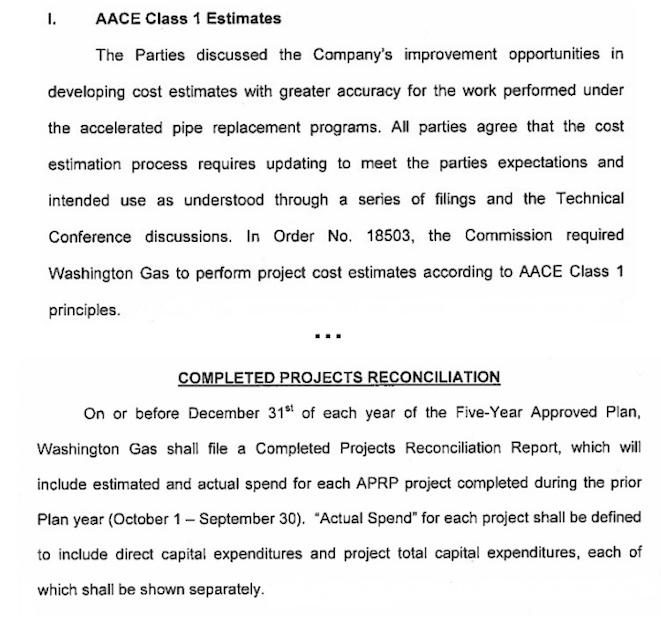
ACCOUNTING PRINCIPLES: Excerpts from DC Public Service Commission documents show expectations for reporting of Washington Gas pipe replacement project costs.
Gas pipe work in the Foxhall area is expected to go on through September 29, 2017, according to a Washington Gas project update dated May 23, 2017. Meanwhile, on March 1, 2017, the Commission announced an order allowing Washington Gas to up its Residential Customer Charge $3.20 per month, an increase from $9.90 to $13.10.
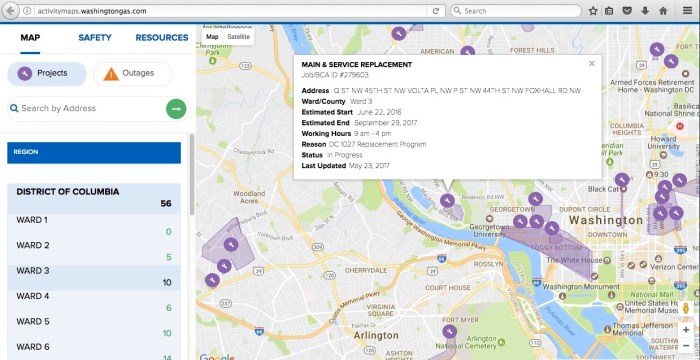
GAS WORK SCHEDULE: An update of Washington Gas pipe project timing in the Foxhall Village area that was posted on the company’s website. On the morning of June 5, 2017, the map showed nothing for the area.


 Potomac Times