John A. Bray, Testimony, December 1, 2016, Georgetown University Campus Plan 2017-2036, DC Zoning Commission Case No. 16-18
Good evening. I’m John Bray. I grew up in Foxhall Village. I live there now and I am a member of the Foxhall Community Citizens Association board.
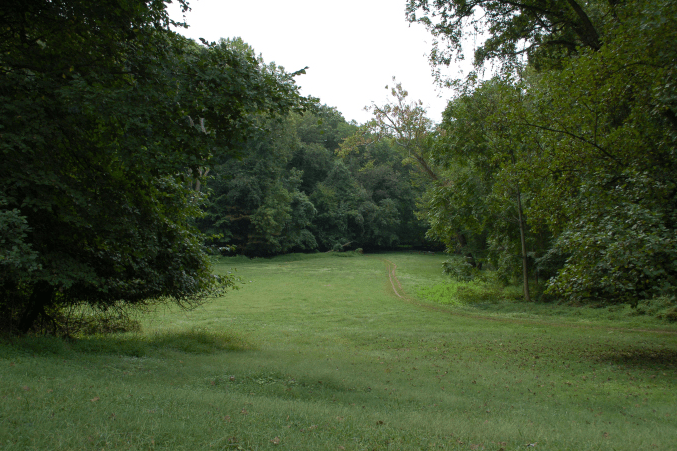
ONCE A LAKE VIEW: The area of Glover Archbold National Park south of Reservoir Road at one time held a lake that was 25 feet deep, according to history that was submitted as part of a successful nomination of the northwest Washington, D.C., woodland to the National Register of Historic Places. File Photo Credit: John A. Bray
GU’s Campus Plan proposal is huge, long-term and complicated, with serious potential for exacerbating congestion in the area and degrading Glover Archbold National Park. The plan entails:
- 1.3 million square feet of new buildings, including a hospital wing and redevelopment on the park border
- 1,120 more full- and part-time university and hospital employees, an increase to 9,684
- Boosted enrollment that will “in significant part” replace students relocated downtown in 2013
- Expanded parking for shared car services and electric vehicle charging stations
- Novel and arcane provisions of the Georgetown Community Partnership regarding how community challenges to plan changes are to be handled
- A new east-west road that is expected to boost traffic at Gate 4 next to the park and add a light on Reservoir Road.
Gaps exist in plan specifications that make evaluation of impact difficult. For example:
- Employee counts do not include certain types of workers
- Certain types of students aren’t counted against the campus enrollment cap of more than 14,000
- The plan doesn’t specify how many shared car and charging spaces will be added and doesn’t count those spaces against the 4,080 cap.
I ask that you require that the plan clarify mitigation for plan elements that are bound to be objectionable to neighbors and spell out accountability for plan implementation and reporting to the public about plan progress.
Without these measures, the dramatic gains in GU-Neighbor relations since the mire of 2010 are put at risk. Already, a benefit to public natural resources that was gained from the campus plan process five years ago is in jeopardy.
I testified here on June 6, 2011, seeking to stop GU’s plan to turn its national park border into a commuter bus thruway. GU had deeded to the United States a “scenic easement” along the border in exchange for millions in federal money to expand its Canal Road entrance. GU eventually withdrew its thruway plan.
Now GU is back with a new plan to intensify traffic against the northern third of the park border. This is bound to further degrade the park atmosphere and visitor sightlines. Border erosion already is substantial. I ask that you require that alternatives be sought that make expanded use of Gate 4 unnecessary or unnoticeable.
As a GU fan, I praise the plan’s stated interest in expanding green approaches of its own devising on its own property. As a GU fan, I hope it will take responsibility to do no harm to a beautiful forest it had no hand in making and that seems obviously in our common interest to protect. Thank you.
References:
“GU Gate 4 Naming Rights Available!,” August 25, 2016, The Hoe.org
“GU’s Loop Road Nouveau,” August 9, 2016, The Hoe.org


 Potomac Times